

Recommended Reading: Genesis 3:1-24
This week, we will dig deeper into Genesis 3, and in the first verse we see a detail that may not immediately stick out; however, in the larger context of scripture, it’s very noticeable. It’s because of this I believe it’s worth mentioning David Steinmetz, and his comparison of reading the Old Testament to reading a mystery novel.[1] In this sense, a second read-through of the same novel highlights’ information that, knowing the outcome, sticks out like a sore thumb. Relating this comparison to our Genesis 3 story, there is the introduction of a serpent mentioned in verse 1; however, the Bible doesn’t declare serpents unclean until Leviticus 11:41-42. From later sections of Genesis, and how its characters often make choices based on instruction given later, it seems that Moses intended the whole Torah to be read together, which would mean that in early narratives he assumes information that will only be supplied later. Following this same understanding, the reader is begged to ask the question, if the Garden of Eden is a prototypical temple, and Adam is the prototypical temple guard/priest, why then is there an unclean serpent inside Eden?
One of the themes in this story speaks of the dangers of entertaining the devil and reminds us of the power God gave us in Genesis 1:28 – the power to rule over every living creature. We know from the previous chapter woman was created out of man, but the sense in which this speaks is more of that which a part of man is missing. It means that man and woman are meant for each other and are whole together; however, both man and woman maintain full individuality. Adam, as keeper of the Garden, could banish this serpent; however, according to the details we have, he does nothing. Eve, as priestess of this prototypical temple, also had this power and authority to banish the serpent and instead gives a listening ear. Eve is obviously aware of a portion of the command given to Adam in Genesis 2:17 although, it may also be significant, she misquotes what God told Adam. Did Adam offer an alternate rendering? Even if Eve truly fell for this deception fully on her own, why is Adam eating the fruit? We know that God explicitly spoke to Adam and told him not to eat of it for whomever eats of it shall surely die. My point here is that while often this blame is placed on one party or another, both parties are at fault, and both have failed responsibilities. According to Genesis 3:6, both were present at the conversation with the serpent, and both were conscious when this fruit was consumed. Eve didn’t add any additional deception above what the serpent had provided.
In this story, Adam is a man who has responsibilities but chose to listen to another narrative. God has given Adam and Eve this garden to live and grow in. They have been tasked with providing for all of God’s creation. God had only one line that could be crossed, one rule with a consequence, and yet the desire for more and curiosity of the forbidden pushed Adam and Eve, together and individually, to set aside their task from God in the pursuit of more. Adam has the additional responsibility of ensuring the protection Eve[2] as she is Adam’s God-given partner and the one in whom Adam will carry out the Genesis 1:28 “be fruitful and multiply” command given by God. This story is clearly an example of people who fail to fulfill their God given roles, while dually, and more importantly, they fail to take responsibility for the failure. It is true that today we may “fall short of the glory of God”[3], but the good news is as we recognize this, we are reminded that we are also covered by the blood of Jesus[4], giving us a clear conscience and free status before God. Looking at the events immediately after the consumption of the forbidden fruit, we see God addresses both parties. When God questions Adam, he, knowing full and well the words of God spoken directly to him, pushed all blame onto the other party. As a leader and a partaker in the same fruit Eve partook, Adam is just as responsible. Leadership is not a role to be held lightly, and as a leader, when the fall comes you take the blame. An unaccountable leader is a scary thing. Adam’s response to God is quite the excuse as he claims Eve just gave him some fruit; however, as mentioned previously, we see in verse 6 Adam was clearly with the serpent and Eve at the culmination of these events. Continuing to pop-up is the idea that Moses is telling his audience the importance of accountability, especially amongst leaders.[5] This is another recurring theme throughout this story and, remembering the context of who this is being written to, is an important reminder to the Israelites of the responsibility associated with leadership. During their time in Egypt, they faced severe oppression from the leaders they were under. God is going to call them to be leaders of God’s nation, of his temple, a kingdom of priests. If we too are to be a kingdom of priests and leaders, we must understand the responsibility associated and the importance of leading with equality, graciousness, and a firm understanding of our role.
Before moving to the back half of this story, I want to make note that this excuse we’ve been discussing, given by Adam, is the center of a chiasmus found in Genesis 3. The chiastic structure, which we will refer to as chiasmus 3.1, can be observed as follows:
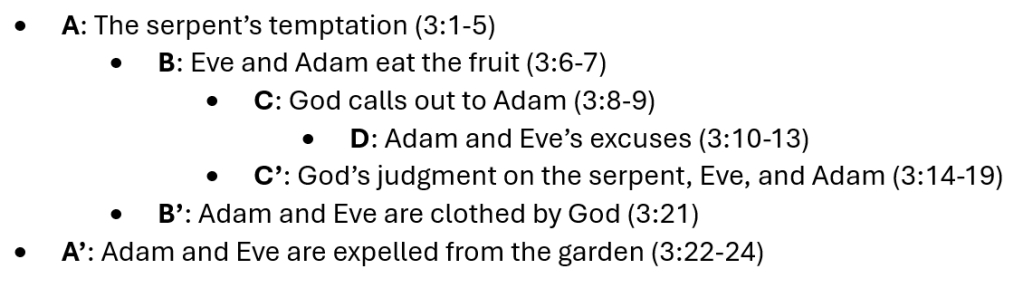
This chiasmus centers around the disobedience of Adam and Eve, and the associated consequences, with the pivotal following moment being God’s judgment; however, this is not the only chiasmus to be found in Genesis 3. Observe this alternate chiastic rendering, which we will refer to as chiasmus 3.2, and we will consider their impact together.

These two chiastic structures are both visible independently and in relationship with each other. In chiasmus 3.1, we see this story forming around the disobedience and lack of accountability for the wrongful actions committed by both Adam and Eve. In chiasmus 3.2, we see this story forming around the curse God gives the serpent. An interesting note on 3:14-15, however, is God only curses the serpent. While both Adam and Eve are punished, they are not cursed. Adam was specifically told the consumption of the fruit from the tree of knowledge, of good and evil, would lead to death; however, while the promise of death will come true in the form of an end of life, this curse towards the serpent is in a sense, a blessing of continued life through the seed of the woman. The curse speaks of a conflict between the seed of the woman and the seed of the serpent that will, eventually, lead to a victorious defeat of the serpent through the woman’s seed and without life, how can conflict exist? If we combine the themes from these two chiasmi, we see that while actions have consequences, God is merciful.
Spoken to the Israelites after the exodus from Egypt, Moses is communicating that while the creation of God has allowed another voice into the picture, it is God who will have the final victory. Furthermore, as Moses continues to reaffirm through similar character developments and intentional genealogy ties, it is from this people group that the head will be bruised. While when Moses authored Genesis 3, he may have not known Jesus was the ultimate seed of the woman through whom the head of the serpent would be bruised, he will continue through Genesis to develop this idea as will other Old Testament authors.
Let’s remember today that we have this same power and authority given to Adam and Eve in the garden. Satan may crouch at our door, but will we give his words a listening ear? We have the same authority Jesus exercised during his 40 days of temptation in which he told Satan to leave. Will I use my God-given power? Let’s also remember that while we may be over two-thousand years set apart from this story, God still holds us to the same level of accountability for our responsibilities. We must take charge for what we are given, and we must be ready to give an account for all our actions before God. Have comments or questions? Please feel free to leave them below! Join us next week as we discuss Genesis 4 and the story of Cain and Abel!
[1] David C. Steinmetz, “Uncovering a Second Narrative: Detective Fiction and the Construction of a Historical Method,” in The Art of Reading Scripture, ed. Ellen F. Davis and Richard B. Hays (Grand Rapids: Eerdmans, 2003), 54-65
[2] See Genesis 1:28, 2:24. I would argue this also is supported from the view Paul took in Ephesians 5:21-33 dealing with the headship amongst a family unit.
[3] A reference to Romans 3:23, in context discussing the idea that we are all equal and no one is of higher status before God. This is specifically for arguments regarding who should be leaders in the church of Rome as the Jews had been exiled and were now returning. Upon return they found Gentile converts who had assumed the necessary leadership roles to keep the local body functioning. This is the dissension Paul dealt with in the book of Romans.
[4] For more information on the blood of Jesus and the eternal sacrifice of atonement, the author of Hebrews discusses this idea. The author reminds the reader that the atonement sacrifice which God put in place was less for him and more for us. The atonement sacrifice of Jesus means we can live freely knowing we have already received grace for our sins, allowing us to focus less on ‘not breaking rules’ and more on being the loving example Christ was for all. This perspective shift puts God and his will at a more central focus over the worry that, to take a classic rabbinic debate from around Jesus’ era, would I be in sin for helping my neighbor free his animal on the sabbath? (See Matthew 12:11-12)
[5] The New Testament speak exhaustively on the roles and responsibilities leaders have. One of which is the responsibility of providing an account before God. (See Hebrews 13:17)
 Discover The Text
Leave a comment