
Recommended Reading: Genesis 2:1-25
Introduction
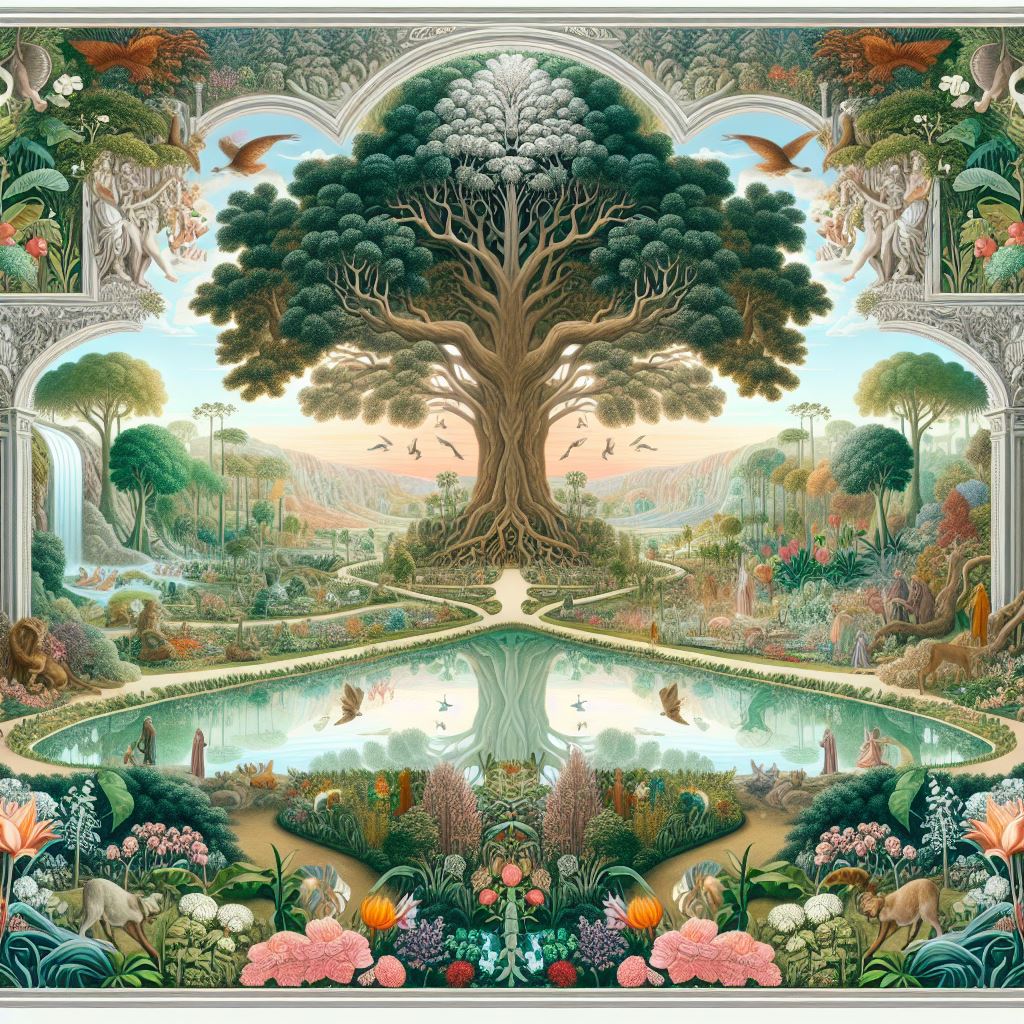
Last week, we looked at the first chapter of Genesis and discussed the creation story. We looked at the Chiasmus in the story and found that Moses was trying to communicate to a previously exiled people, God wants us to rest. Moving into Genesis 2:4 – 2:25, we immediately start off with a problem if we try to read these stories as purely chronological. Following the creation story in Genesis 1:1 – 2:3, and the seventh day of rest and completion of the creation, we are presented with another account of the heavens and earth being created. As each of these stories are meant to convey a specific point, or many, to the audience, we can view this second creation story as the same, but with a different, narrower, focus. This passage provides a more detailed account of the creation of humans and their role, focusing on the formation of Adam from the dust, and the creation of the woman (named Eve in Genesis 3:20) from Adam. This emphasizes the intimate and personal nature of human creation. The Garden of Eden is described as a lush, well-watered paradise with four rivers flowing from it.
This setting underscores the abundance and provision of God for humanity. Due to the many parallels, the Garden of Eden is often seen as the prototype temple. Observe some of the parallels below:
- The Garden of Eden is described as the place where God walked and talked with Adam and the woman, indicating His presence among them. Similarly, the temple is the designated place of God’s presence among His people
- The entrance to the Garden of Eden was on the east side (Genesis 3:24). Likewise, the entrances to the tabernacle and the temple were also oriented towards the east (Exodus 27:13-16; Ezekiel 43:1-4)
- After Adam and the woman were expelled from Eden, cherubim were placed to guard the entrance (Genesis 3:24). In the temple, cherubim were depicted on the Ark of the Covenant and on the curtains, symbolizing their role as guardians of the holy place (Exodus 25:18-22; 1 Kings 6:23-29)
- The Tree of Life in the Garden of Eden is often compared to the menorah (lampstand) in the temple, which had a tree-like design with branches and almond blossoms (Exodus 25:31-40). This symbolizes the life and light provided by God.
- A river flowed out of Eden to water the garden (Genesis 2:10). Similarly, the temple is associated with a source of water, symbolizing life and purification (Ezekiel 47:1-12; Revelation 22:1-2)
- Adam’s role in tending and keeping the garden (Genesis 2:15) is seen as a priestly function, similar to the duties of the priests in the temple who were to serve and guard the sanctuary (Numbers 3:7-8)
The creation of the woman from Adam and the subsequent declaration that a man shall leave his father and mother and be united to his wife establishes the foundation for marriage and companionship. In its historical context, this verse is actually counterintuitive given the traditional practice where, in ancient Near Eastern cultures, a woman typically joins her husband’s family. This idea that God sees the marriage relationship as creating a new, primary family unit becomes even more important later when Israel is called to enter into a marital relationship with God. When God calls his people into a marital covenant with him, he asks them to have both a communal and a personal devotion to him. By challenging the cultural normative, God is reminding his people that the relationship they are entering into is above all else. Another theme seen here, based on later events, is that God calls his people to be different and set apart from the world. This is to be so the other nations will recognize Israel by their differences. This instance is no different, as this idea that something is above the family structure would’ve been viewed as absurd.
My last note regarding this passage is that it is chiastic. While this extended chiasmus is more subtle, it culminates around a verse I’ve discussed previously, Genesis 2:10-14. Water is a substance required for life. Even the driest desert cactus holds on to the reserves of moisture it has. The idea of these four rivers flowing out of the Garden of Eden speaks of the life God will give all the Earth from his temple, his holy land, and his people. Observe the chiastic structure below:
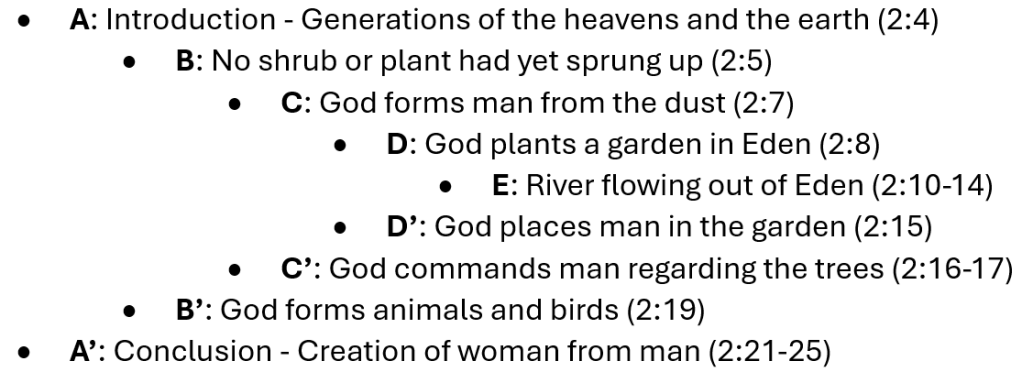
God has called both Adam and us to be stewards of his creation, serving in a priestly capacity to maintain and care for the sacred space. These four rivers speak to the later idea that it is from God and his people that all nations will be blessed.
Overview
These first two chapters of Genesis are packed full of information, and this write-up doesn’t even begin to scratch the surface! From the introduction of the Bible, we are already dealing with complex issues surrounding the balance between work and rest, and the defining of who we are called to be. God’s creation is perfect, and his choice to rest means he is content with the job he has done. God is the artist, and we are the painting. There becomes a point where a brush stroke too many and the painting is past its prime. God knows when it’s time to be done and he takes time to rest, as should we. Furthermore, it is from God and his temple, living in us, that the world gets to experience his goodness. We are called to fulfill our priestly roles and keep the rivers of Eden flowing from our hearts into the world.
As we reflect on this story, we can ask ourselves how we can let the rivers of Eden flow from the temple inside us and bless those around us. God doesn’t say we need to share our theology with everyone we meet, but a simple hello or a nice gesture, caring for anyone in need, is the true nature of the kingdom. Have questions or comments? Please leave them below! Join us next week as we discuss Genesis 3 and figure out what’s really happening in the garden!
 Discover The Text
Leave a comment