

Recommended Reading: Genesis 1:1-2:4
Introduction to The Book of Genesis
Genesis is the first Book of the Torah, or the Pentateuch. The Torah comprises the first 5 books of the Bible, whose original authorship is traditionally attributed to Moses. The Torah was given to Moses, by God, after Israel’s exodus from Egypt. In Egypt, the Israelites (also referred to as the Hebrew’s, and, later, the Jewish people) had spent 400 years in slavery. Moses, chosen by God to lead this people group out of exile, is tasked with reminding this people group of who they are and what they are called to be.
The Opening Verses
In Genesis 1:1-2, we are reminded who God is and where he’s from. We are reminded he is before the beginning, and he is the creator of all. We are also reminded that no other deity is comparable to God (Heb. אֱלֹהִים), as God alone created the heavens and the earth. This is in direct contrast to the Polytheistic views of the Near Eastern societies that surrounded Israel. Specifically, this contradicts the Egyptians and their creation myths. Creation stories were common throughout Near Eastern cultures as they provided a backstory to their culture and spoke of their purpose for the gods. As we continue to look at the creation story in Genesis, we will contrast the details to those of other Near Eastern cultures and observe the key differences that set God apart from the gods of these other cultures. Another interesting note on verse 2 is the inclusion of the phrase “formless and empty” (Heb. תֹּהוּ בֹּהוּ). The phrase can be translated in its literal sense to “chaotic emptiness” and the verse can be read “Now the earth was full of chaotic emptiness”. The idea of chaotic emptiness sparks a feeling of a powerful rushing wind that goes where it pleases. This fits perfectly as the next part of the verse speaks of God’s spirit moving over the waters, hovering and remaining in and around His creation.
The Creation Story
As mentioned previously, the creation story in Genesis gives God’s people an origin story and a purpose. Common creation stories include Enuma Elish (a Babylonian creation myth), Atrahasis (an Akkadian creation myth), and Egyptian creation myths. All of these stories provide these Near Eastern cultures with origin and purpose, and they would’ve been well known. Specifically, Egyptian creation myths often start with the emergence of the world from a primordial watery chaos. The god Atum or Ra creates other gods and the world through various means, such as speaking or self-generation. Compared with the Genesis account, as soon as God has created the heavens and the earth, the earth is filled with “chaotic emptiness” and God’s spirit is seen “hovering over the waters.” Differentiating from all these stories, in the Genesis account, God does not create other deities. He, himself, is enough and does not need any help or assistance from other gods. This detail begins the separation of the God of Israel and other Near Eastern cultures as Israel is instructed to be monotheistic. God, also, creates humans in his image and gives them purpose, while in other myths, humans are created to either serve the gods or the gods need the humans to do their work. Furthermore, the concept of a day of rest is unique to the Genesis creation account. The idea of being created in God’s image by itself has many profound ideas, but one relevant to this account is the idea that we reflect God, and we too should take the time to rest.
The Chiasmus in The Creation Story
This idea of rest moves us into my next take away: the creation story in Genesis contains both a chiasmus and a parallelism. As this is the first time we’ve encountered these literary tools, let me explain what they are.
A chiasmus, more common in Near Eastern literature, is a literary tool involving the inversion of the order of words or ideas in parallel phrases or clauses, creating a mirror-like structure and allowing an author to highlight their main focal point. A parallelism involves the repetition of similar grammatical structures or ideas in successive lines or sentences.
In the creation story, we have both an extended chiasmus and a chiastic inverted parallelism. The extended chiasmus can be observed with the following structure:
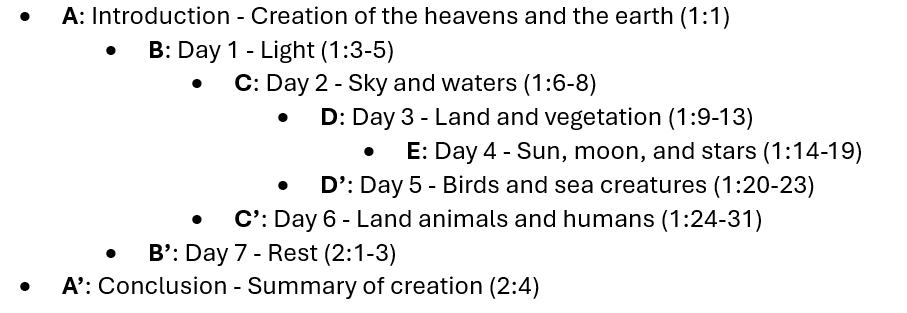
This chiasmus comprises 9 sections between 1:1 and 2:4. Of the 9 sections, 8 of them reflect each other while the 9th marks the center.
- In the A and A’ sections, we see the introduction and conclusion frame the entire creation narrative, emphasizing the completeness and orderliness of God’s creation.
- In the B and B’ sections, the creation of light and the day of rest highlight the rhythm of work and rest, which is foundational to the concept of the Sabbath.
- In the C and C’ sections, the separation of sky and waters and the creation of land animals and humans show the progression from forming to filling.
- In the D and D’ sections, the creation of land and vegetation and the creation of birds and sea creatures illustrate the diversity and abundance of life.
Finally, these 4 mirrored sections culminate in 1:14-19, the creation of the sun, moon, and stars, as the central element, underscoring their importance in marking time and seasons. This establishment of time and the cycles of days and seasons sets the state for the seventh day, the Sabbath, where God rests. This rest is not just a cessation of work but a sanctification of time itself.
The chiastic inverted parallelism can be observed with the following structure:

Not all parallelisms are chiastic, but this one happens to be. The chiastic structure is as follows: The first three days (creation of domains) are mirrored by the second three days (filling of domains), with the seventh day serving as the central focus. The seventh day, where God rests, is the culmination of the creation account. This day of rest emphasizes the completion and sanctification of creation. The number seven is also often used throughout biblical literature to symbolize completeness and perfection. By sanctifying the seventh day, God invites humanity to participate in his rest. This rest is not merely physical but also spiritual, offering a time for reflection, worship, and renewal. Day 7’s significance in the chiastic structure of Genesis 1:1-2:3 highlights the importance of rest, sanctification, and the completion of creation. It serves as a divine model for the rhythm of work and rest, emphasizing the holistic nature of God’s creation.
“Thus the heavens and the earth were completed in all their vast array. By the seventh day God had finished the work he had been doing; so on the seventh day he rested from all his work. Then God blessed the seventh day and made it holy, because on it he rested from all the work of creating that he had done.”
(Genesis 2:1-3 NIV)
Overview
This story, written to a people group who have just escaped a brutal, long, oppression, tells of a God who made man in his image and, just as God does, calls man to not only work but also rest. This story is placed at the very beginning, and from the start we see how much God cares for His people. Compared to other creation stories where man is created only to serve and do the manual labor the gods so desperately need completed, our God needs nothing and invites us into the holy act of resting.
As we reflect on this story, we can ask ourselves how we can take part and benefit from this rest. God invites us into a space where all we have to worry about is us and Him. Slowing down, and resting, might not come easy as it is counterintuitive to most of the western worldview; however, if we take the time to do so, the benefits reaped will be plentiful. Have questions or comments? Please leave them below! Join us next week as we discuss Genesis 2 and a possible second creation story on our journey through Genesis!
 Discover The Text
Leave a comment