

Recommended Reading Before Discussion
- Matthew 1:18-2:23
- Luke 1:26-2:40
Have you ever wondered why only 2 of the 4 gospels include the birth story of Jesus? And out of the 2 gospels that do share the birth story of Jesus, why are they so different? Today let’s dig deeper into our text and learn what’s going on here. We’ll take a look at what we can learn from this discrepancy regarding the 4 gospels, what we can take away from these 2 stories individually, while raising a question surrounding the harmonizing of these 2 accounts.
So, what’s going on here? The first thing we need to understand is that the word gospel means “good news.” Each gospel writer has a specific audience in mind for their version of the good news. This is important because when we read a gospel account, we need to remember to look for what the audience would’ve seen. Matthew, for example, was written to a primarily Jewish audience. There are lots of instances throughout the book of Matthew, that to a Jewish audience, would stick out like a sore thumb. An example would be the Genealogy Matthew outlines in chapter 1. This genealogy contains many figures that are uncommon to find in a traditional genealogy (non-Jews, women, societal outcasts, etc.). Matthew, a former tax collector, an outsider/outcast in his world, identifies Jesus with the outsider. He focuses, throughout his gospel, on the outsider. Mark, however, focuses more on a Roman audience with a more Hellenistic, action-packed, approach. Matthew incorporates more Remez and traditional eastern literary tools; whereas, Mark’s gospel is faster paced and more direct. There are many theories on Luke. Some support the idea Luke was written for gentile converts, and/or King Agrippa II/The house of Caesar as Paul was preparing for testifying before Caesar. Some support the theory Luke was written for early church reading during the annual Torah cycle reading. Regardless of the specifics of Luke’s audience, it is worth mentioning that Luke mentions more parallel parables directed towards women than any of the other gospels. John’s gospel was written for the churches in Asia-minor. This is in and around modern-day Turkey. John wrote to a 20% Jewish audience and, whether intentionally or accidentally, is able to clearly communicate both intellectually deep Jewish points and Greco-Roman points in the same verse.
Understanding that each Gospel is written to a specific audience to help them better understand the good news of Jesus helps us understand why there might be different details in these stories, as well as why writers chose not to include the story all together. Let’s talk about what’s the same and what’s different between the stories. The Venn diagram below shows a few of the differences that between the 2 Gospel narratives that include the story of the birth of Jesus.
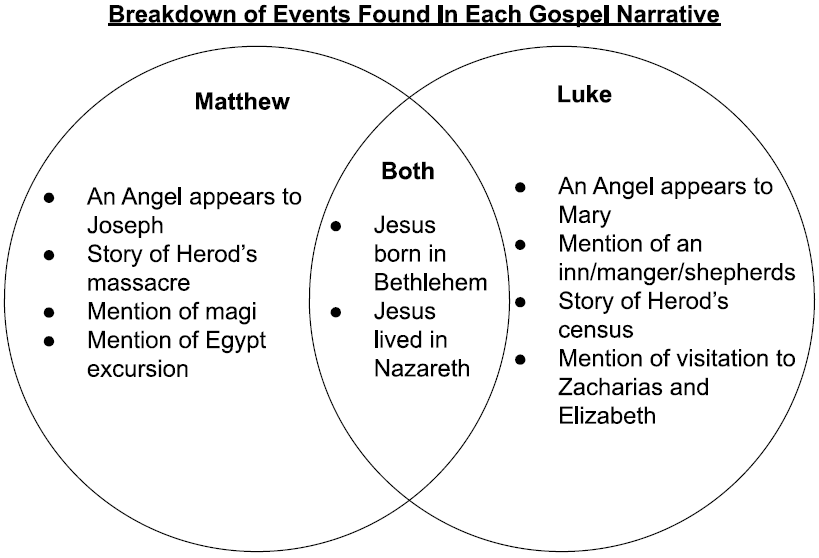
So why are these stories so different? Why do they have so little in common? The answer is that each of these stories were recorded by the original authors to teach us something different. While they may provide historical insight into the birth of Jesus, each of these stories provides even deeper meaning to the original hearers of each gospel. Understanding this, the question becomes: what can we learn from each of these stories. Let’s dig deeper into both accounts and see what the original writers were trying to communicate.
In Matthew’s account of the birth of Jesus, Matthew focuses on the fulfillment of the Old Testament scriptures. This would be very important to the original audience as Matthew was trying to communicate to his Jewish brothers and sisters that Jesus truly was the Messiah whom they were searching for. Throughout Matthew 1:18 – 2:23, there are multiple sub-themes that can be pulled. Joseph continually is obedient to God and tries to be loving, even when carrying out tough laws (Mt 1:19). It is also Joseph’s obedience and faith to God that allows the events to be carried out in the way they were. Jesus is also portrayed as a ruler, or a king, on multiple occasions. The picture of a star rising is pulled from Numbers 24:17, but along with the scriptural reference, this phrase has a cultural application. In a brilliant political move to ensure the throne of the Roman Empire around 44 B.C.E., Octavian took advantage of a comet seen all throughout the empire and made a statement that the comet was a sign that his father, Julius Caesar, was divine. This phrase in Matthew would not only strike a listener as an answer to the prophecy in Numbers 24:17, but also as a message that Jesus is the true divine.
While Matthew appeals to his Jewish audience on the basis of Jesus being their true king, Luke appeals to his audience on the basis of Jesus’ humble beginnings. Luke also focuses more on Mary than Joseph. While in Matthew an angel appears to Joseph on the basis of him trusting that this baby truly is from God, in Luke the angel appears to Mary, providing comfort and a promise of protection. This is significant as Jewish law is very specific that both the adulterer and adulteress are to be put to death (Leviticus 20:10). We know in Matthew that Joseph’s character was more of mercy and, without fully understanding the situation, did not want to accuse Mary of something that, for all he knows, may have not been her choice; however, if we only read Luke, we cannot come to that conclusion. This is a significant difference that highlights God’s care and love for the marginalized. We also see later in the story what is commonly referred to as “The Magnificat.” This is a song, written and sung by Mary, that contains countless allusions towards the Old Testament (Luke 1:46-56). Shown a few times throughout the gospels, we see that Mary has a devotion to God and His words. Her use of Old Testament scripture and passages tells us of the faith she has.
“But the angel said to [the shepherds], “Do not be afraid. I bring you good news that will cause great joy for all the people.”
(Luke 2:10 NIV)
Moving further along in Luke, we see Jesus’ humble beginning, spending his first night out of the womb in a manger. We see shepherds, more than likely raising sheep for temple worship and even more likely social outcasts, are visited by the same angel as Mary. They’re told that a savior has been born for them, and they should find the baby wrapped in cloth and lying in a manger. Throughout Luke’s narrative of Jesus’ birth, he takes the time to remind his audience that Jesus is the savior of all, and God is for all. No matter our story or what path we’ve either taken or been given, God is here for us! God sent Jesus, not for a specific people group, or gender, or social status, but for all to freely know God and share in His blessings.
It can be easy for stories like Jesus’ birth to become routinely harmonized and for us to forget what details happen where and how those different details lead to different points. As we continue to wrestle with these two passages individually, let’s look at other passages that may have become routine and passages that may appear in multiple books. Let’s try to read these stories without inputting any details we remember being there and see if we can learn anything new. Are you find anything interesting in your favorite Bible stories? What are your thoughts on Jesus’ birth story? Let us know using the comment section below!
 Discover The Text
Leave a comment